
Why a framed mirror does more than reflect
A mirror is often treated as a practical item, but once it is framed properly it becomes part of the room’s structure. In a South African home, that matters. A well chosen frame can pull a loose room together, echo timber floors or steel finishes, and make a narrow hallway in Parkhurst feel more open. It also gives the mirror a cleaner edge, which is useful when you want the piece to look intentional rather than simply added later.
For galleries and hospitality spaces, a framed mirror can do even more. It can break up a wall of artworks, create a pause between framed pieces, or reflect natural light into a reception area. In summer months, when bright sun can hit a room at an angle, the frame helps the mirror read as a design feature instead of a plain reflective surface.
Choosing the right frame for the room
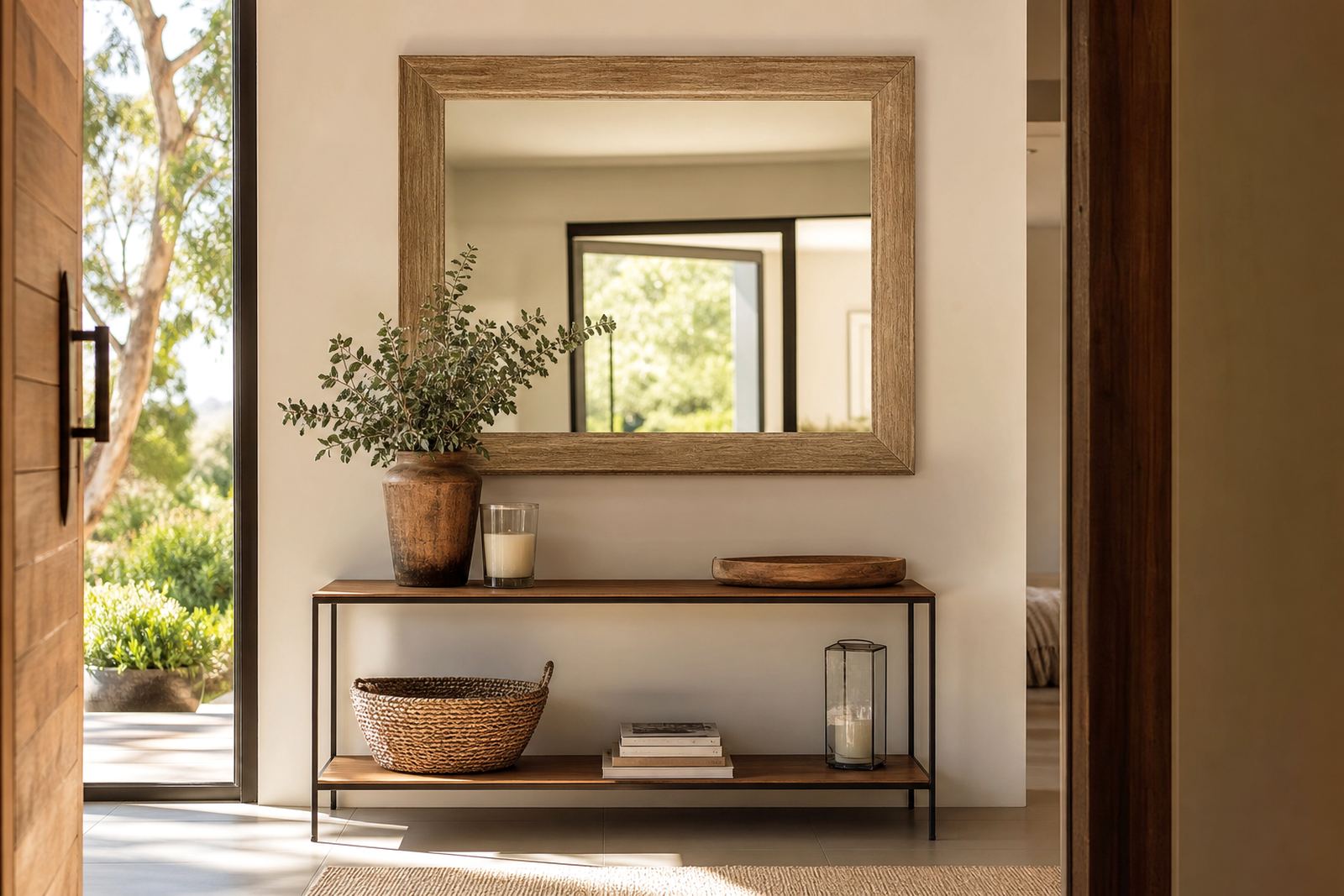
The best frame depends on where the mirror will live and how much visual weight the wall can carry. A slim frame works well where the room already has strong lines, such as modern tiles, built in joinery, or simple plaster walls. Wider profiles suit statement pieces over a console, fireplace or sideboard, especially where you want the mirror to anchor the room.
Material choice matters too. Timber frames bring warmth and work well in bedrooms, dining rooms and older houses. Painted finishes can sit neatly in lighter interiors or coastal properties where humidity may affect some finishes over time. Metal look styles suit more contemporary spaces and are useful where the room already has black, brass or graphite fittings.
- Choose a narrow profile for small rooms so the mirror does not overpower the wall.
- Use a deeper frame when the mirror needs to act as a feature piece.
- Match the finish to nearby fittings, flooring or cabinetry for a more settled look.
- In humid areas like Durban, ask about materials and backing suited to coastal conditions.
Sizing rules that prevent common mistakes
Mirror framing works best when the size feels balanced with the furniture below it. A mirror hung over a couch, sideboard or basin should usually be slightly narrower than the item beneath it. If it is too wide, the wall can feel cramped. If it is too small, the piece looks lost.
Height matters as well. In a passage or dressing area, the top edge should sit high enough to give good reflection without forcing people to duck or stretch. In family homes, especially where children are using a bathroom mirror, a practical height is often more useful than a purely decorative placement. For gallery spaces, consistent spacing between mirrors and artworks keeps the wall tidy and easy to read.
- Measure the wall and furniture together, not the mirror alone.
- Leave breathing room around switches, skirtings and cornices.
- Check the viewing height from the main standing position, not only when seated.
- For heavier pieces, plan fixings before the mirror is framed so installation goes smoothly.
Framing mirrors for Johannesburg light and load-shedding
Johannesburg light can be sharp in the morning and flat later in the day, so the right framed mirror helps manage the feel of a room. Place one opposite a window if you want to bounce daylight deeper into the space, but avoid angles that throw glare onto a television, workspace or dining table. In Parkhurst and Rosebank homes, mirrors often work well in entrance halls where they catch light from a front door or side window.
Load-shedding also changes how a room works after dark. A mirror near a lamp, wall light or candle cluster can help spread a softer glow, which is useful in living areas and guest bathrooms. This is one reason framed mirrors are often requested for apartments and compact homes in Johannesburg and Pretoria. They help a room do more with the light it has, while still looking neat when power is off.
A local example: a narrow passage in a Parkhurst townhouse can feel dark even during the day. A vertically framed mirror on the longest wall, with a timber finish that echoes the floor, can open the space visually without needing major renovation. It is a small change but it often makes the passage feel more usable.
When a mirror should be repaired or reframed
Not every mirror needs to be replaced. If the glass is sound but the frame is chipped, dated or not suited to the room anymore, reframing can be the sensible option. This is especially true for family pieces, older mirrors with good proportions, or mirrors that need to be adapted for a new home. Frame repairs can also help if a corner has lifted, a moulding has damaged, or the finish has faded unevenly.
Reframing is useful when the mirror needs a more formal look for a gallery, salon or reception space. It can also solve practical issues such as a frame that is too shallow, damaged by moving, or unsuitable for wall mounting. Where the mirror is large, handling and fixing need care so the piece stays level and secure once it is on the wall.
Style ideas that suit homes, galleries and commercial spaces
Mirror framing does not have to be fussy. The simplest solutions are often the strongest. A clean painted edge can suit a bathroom or studio. A wider timber frame can soften a room with hard floors and concrete finishes. For a gallery or retail wall, a neutral frame keeps attention on the reflected light and the surrounding work, rather than on decorative detail.
When advising on mirror framing ideas, it helps to look at the whole room rather than the mirror in isolation. Consider the colour of walls, the finish of nearby furniture, and whether the room needs warmth, contrast or a little order. A frame can either blend in quietly or act as the point that holds everything together.
- Use a classic rectangular mirror for passages and dining rooms.
- Choose an arched or softened shape if the room has many hard corners.
- Keep bathroom frames practical and easy to wipe down.
- For commercial spaces, choose finishes that are easy to maintain with regular cleaning.
How Bright Frames handles mirror framing projects
At Bright Frames in Parkhurst, mirror framing is approached the same way as any other custom framing job, with attention to proportion, material and the final use of the piece. The team works with homeowners, photographers, galleries and businesses across Johannesburg, Pretoria, Midrand, Sandton, Rosebank, Cape Town and Durban. Some clients come in with a simple idea, others bring measurements, photos and a wall colour sample. Both are useful.
Our service includes design consultation, custom framing, ready-made advice, glass replacement where needed, and collection and delivery for larger pieces. If a mirror needs to fit a specific wall or match an existing room, the safest route is to plan the frame around the space from the start. That way the finished piece looks right, hangs properly and serves the room instead of fighting it.
For homes, galleries and office spaces, a framed mirror should feel settled from day one. The best result is usually the one that looks like it has always belonged there, even if it was only added last week.