
Start with the artwork, not the box
Before you reach for packaging, check what you are sending. Framed prints, original paintings, canvas work, mirrors and photo pieces all need slightly different preparation. A framed item with glass needs surface protection and corner support, while a stretched canvas needs space so the front surface does not touch anything hard. If you are sending multiple pieces, sort them by size and fragility first.
In Johannesburg and Pretoria, many artworks travel by car between homes, studios, galleries and installation sites. In coastal areas such as Cape Town and Durban, humidity can also affect paper and timber frames, so it helps to keep each piece dry and covered until it is loaded. If an item has loose fittings, hanging wire or a wobbly backboard, deal with that before transit.
- Check for existing chips, cracks or lifted frame corners
- Remove dust with a soft, dry cloth before wrapping
- Note whether the piece has glass, acrylic or no glazing
- Keep original labels, certificates and hanging hardware together
Use sleeves and clean layers first
The first layer should protect the surface, not press into it. For most framed work, use a clean acid-free sleeve or a soft archival wrap over the front, then cover that with a smooth protective layer. Never tape directly onto artwork, mount board or glass. If tape is needed on the outer wrap only, keep it away from the frame face and corners.
For canvas, leave a small air gap so the surface does not rub. For mirrors and framed photographs, make sure the protective layer is flat and free from grit. Sand, dust and tiny chips can scratch glazing during a short trip across Sandton or Midrand, so every layer should be clean before it goes on.
- Use a dust-free sleeve or soft wrap on the artwork surface
- Seal only the outer packing, not the frame or glazing
- Keep moisture away from paper, board and timber
- Wrap each piece separately, even if it is travelling with others
Build padding that stops movement
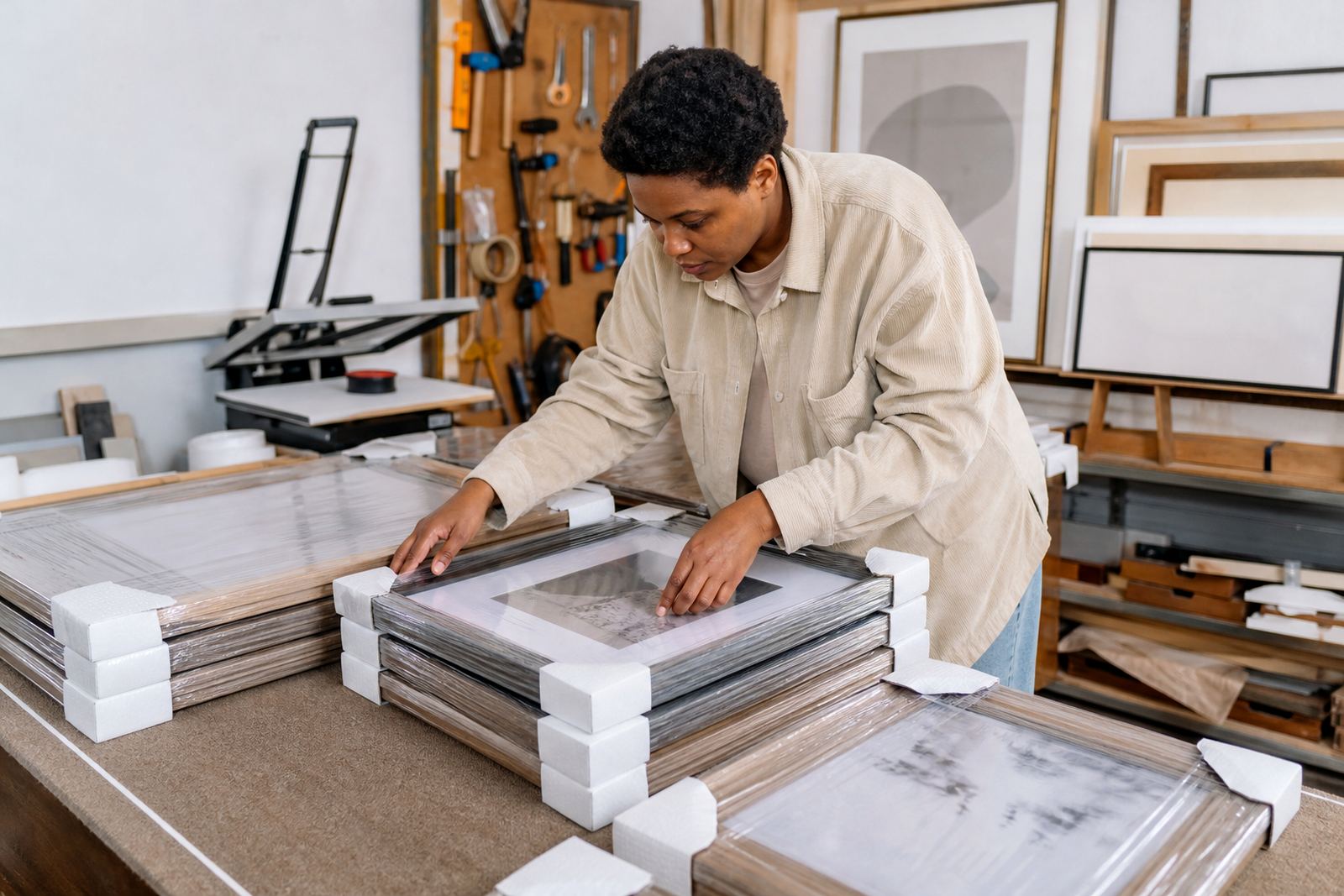
Padding should stop shifting, not squash the piece. Foam corners, cardboard edge guards and layered wrap help protect the vulnerable parts of the frame. If the item is large, add extra support along the back so the centre does not flex during loading. A framed piece that moves inside the parcel is far more likely to crack than one packed snugly.
For collections going to galleries in Parkhurst, Rosebank or central Johannesburg, use a box or crate size that matches the artwork closely. Too much empty space means the piece can slide around, especially on speed humps, potholes and sharp turns. If you are sending work to Cape Town, Durban or elsewhere in South Africa, think about handling at depots too. Parcels are often stacked, so the outer shell must carry the load.
- Protect all four corners with firm corner pieces
- Add a flat board or sheet behind large frames for support
- Fill gaps with clean padding that will not compress too much
- Mark each package with the correct upright position if needed
Choose a stable outer package for the journey
The outer packaging should protect against knocks, pressure and moisture. Double-walled cartons work well for smaller frames, while larger or valuable pieces may need a custom crate or reinforced case. If the artwork is travelling with other items, make sure nothing heavy can sit on top of it. A box that looks tidy but bends when lifted is not ready for transit.
For long-distance delivery between Johannesburg, Pretoria, Cape Town, Durban and Midrand, the package should be easy to carry and clearly marked. On rainy days, add an outer moisture barrier. On hot days, do not leave the parcel in direct sun for long periods, especially if it contains paper, timber or glue joints. Load-shedding can also delay dispatch times, so it helps to have packing finished well before collection.
- Use a strong outer carton or crate matched to the item size
- Reinforce seams and corners so the package holds its shape
- Keep the artwork centred inside the outer shell
- Label the outside clearly: fragile, upright and do not stack where relevant
Prepare for collection, courier or hand delivery
When the piece is ready, keep paperwork and handling notes together. If the artwork is valuable, note the dimensions, frame type and any existing marks. This helps the person collecting it handle it properly. If the item is going straight to an installation, confirm where it will be opened and who will be present to receive it.
For gallery hanging or home installation, we often recommend a final check before the truck leaves. A quick inspection can save time later if the item needs to go up on a wall the same day. If you are preparing several pieces for a show or office fit-out, arrange them in the order they will be unpacked. That makes it easier to move them without confusion.
- Keep a simple list of the pieces being sent
- Photograph the front, back and corners before wrapping
- Confirm who will receive the package at the other end
- Set aside hanging hardware, labels and certificates separately
Common mistakes that cause damage in transit
Most transport damage comes from a few avoidable mistakes. Loose packing, direct contact with hard surfaces and exposed corners are the main culprits. Another common issue is using tape or cling wrap too tightly over a finished surface, which can leave marks or pull at delicate materials. If a package feels light but unstable, it usually needs more internal support.
Pay close attention to older frames and repaired work. A frame that has already been fixed may need gentler handling than a new one. If the piece has been stored in a garage, storeroom or humid space, let it acclimatise before wrapping so trapped damp does not sit under the protective layers.
- Do not let glass touch the back of the artwork
- Do not leave empty space inside the box
- Do not wrap damp or dusty pieces straight away
- Do not use weak tape on heavy packages or large frames
When a prepared delivery needs expert handling
Some items need more than basic wrapping. Oversized art, mirrors, stretched canvases and heirloom pieces may need custom framing adjustments, re-glazing, stronger backing or installation support before they move. If you are unsure whether a piece is ready to travel, it is better to check first than to fix damage later.
Bright Frames works with clients across Parkhurst, Johannesburg, Pretoria, Sandton, Rosebank, Midrand, Cape Town and Durban who need careful preparation for artworks on the move. Our studio team can advise on packing for delivery, collection and installation so the piece arrives in good condition and is ready for hanging.
If you are sending work for a home, gallery or office, the goal is simple: keep it clean, still and protected from end to end. Proper preparation gives the artwork the best chance of arriving without stress, scuffs or unexpected repairs.